Female Chest Pain, not a broken heart!

Most people identify chest pain with the crushing pressure or elephant setting on your chest. Did you know that heart disease is the NUMBER ONE killer in the US for women? I bet if you are a woman, you didn’t know that….1 in 5 deaths for women are related to heart disease. I get the feeling that a lot of you feel that heart disease is more of a man’s disease though, that’s why I’m trying to wisen you up today!

First, let’s talk about PREVENTABLE risk factors for heart disease—YES PREVENTABLE! Diabetes, overweight and obesity, smoking, excessive alcohol use, physical inactivity, and unhealthy eating. Does any of those apply to you? We’ve already discussed activity and diet, and I suspect you all are are aware of the dangers of smoking, obesity and excessive alcohol. We still haven’t had a discussion regarding diabetes, but just being a diabetic increases you risk of heart disease and being a poorly controlled one increases it even more. Also, cholesterol—we talked about those numbers, what they mean and how to keep them down—get to work!

So female presentation of chest pain doesn’t always show up as typical crushing chest pain-the kind we often see in men. It is more sneaky and often easier to dismiss as something else. Heartburn, muscle pain, bad sleep, stress, etc. Women are notorious for putting things off, to keep up their roles as caretakers for the family. They may ignore symptoms they think are other things but that can be very serious. Nausea and vomiting, chest pain (not always), neck pain, jaw pain, pain in upper back, fatigue, indigestion, fainting, shortness of breath, or pain in the upper abdomen can be signs of a heart attack in women. They may only have ONE of these symptoms or they may have more than one.

IF YOU THINK YOU ARE HAVING A HEART ATTACK: CALL 911! Don’t wait! Seriously! Do not drive yourself. EMS personnel can provide life-saving treatment at your home, in your home, immediately! If you go to the ER, you will not get inside quickly, you may have to wait—Don’t wait! If you have aspirin laying around, CHEW one up and swallow it. This will help you to prevent clot formation during a heart attack.

Hopefully, this short post will bring to your attention some of the differences with women and chest pain. A lot of this is preventable. I’m going to post a couple of good graphics, the first is female heart disease deaths by county 2018-2020. The darker the color the worse is is-the southeast glows!!! The second is a visual of the chest pain differences between men and women from the American Heart Association. Be heart wise!!
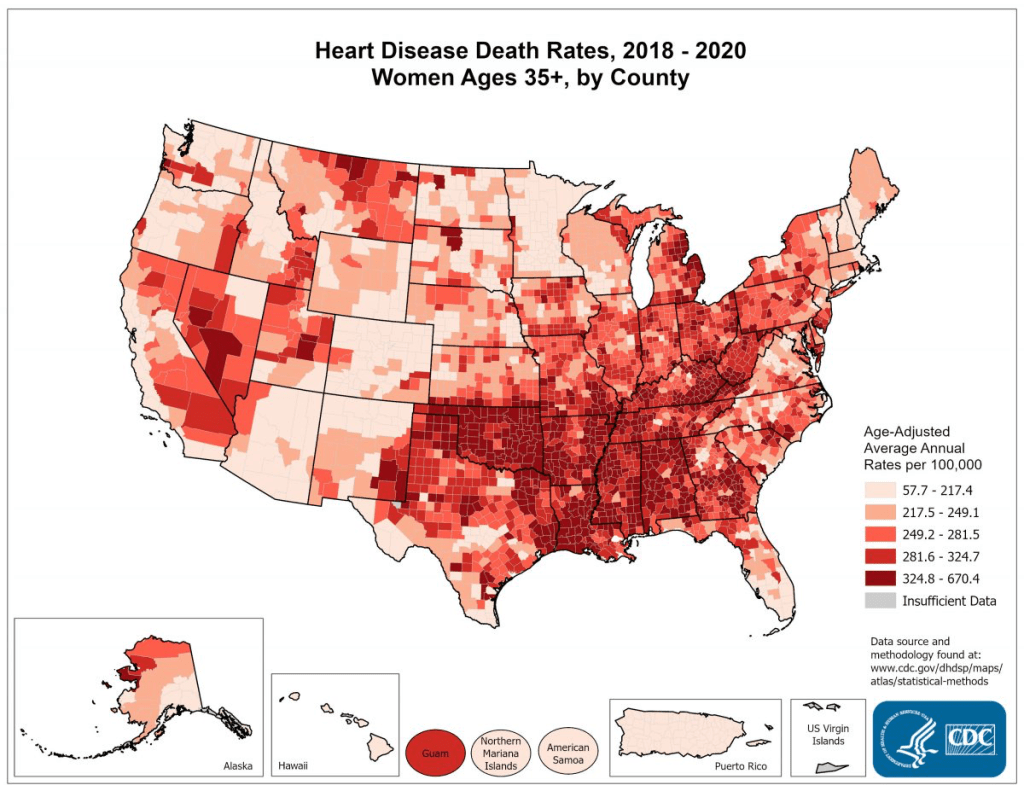
Source: CDC
Source: American Heart Association, Go Red for Women

Sources: https://www.goredforwomen.org/en/about-heart-disease-in-women/signs-and-symptoms-in-women/symptoms-of-a-heart-attack. https://www.cdc.gov/heartdisease/women.htm https://www.health.harvard.edu/heart-health/aspirin-for-heart-attack-chew-or-swallow

To Sleep or not to Sleep, that is the Question…

Sleep Apnea is often undiagnosed or ignored. Chances are if the loved one you cohabitate with at night, snores loudly, or quits breathing for periods during the night they have what is known as Obstructive Sleep Apnea. These people will sometimes grin and say “well, I slept all night, I don’t know what they are talking about.” But yet, they fall asleep at the drop of a hat, or feel frequently fatigued all day long. In clinical practice, I find that these people are most likely to deny that they have a problem or admit to feeling bad. Most of the time, feeling bad has become such a “normal” to them that they don’t even realize they feel bad.

So WHAT is sleep apnea? First of all it affects 20% of ALL Americans. Look around you, chances are there is someone untreated near you!There are several types, but the most common type we deal with in primary care is obstructive sleep apnea (OSA). This occurs when your muscles in your throat relax at night and your tongue, uvula (the hangy-down thing in the back of your throat), tonsils, or just a large amount of tissue around your neck pushes on, narrows, or closes your airway at night. You may be sleeping, but you are starving you inner tissues of oxygen because you can’t get enough oxygen down your throat. So you may say, I sleep just fine, but your tissues are not resting because they do not get the oxygen they need at night, causing chronic damage!! Risk factors for sleep apnea are obesity, large neck circumference, male, older, smoker, nasal congestion, or family history. As a provider, I have seen patients with serious OSA that have none of the above!

How do you DIAGNOSE sleep apnea? There are basically 2 ways, an overnight sleep study and at home sleep study. The overnight sleep study will provide detailed information such as lung and brain activity, breathing patterns, arm and leg movement, heart patterns snd oxygen levels. It is a much more in-depth study and sometimes the only one insurance companies will allow due to it’s accuracy. I have seen my own patients have their oxygen drop into the 50’s at night (normal is 90’s), and stop breathing (apnea) for up to 30-45 seconds at a time. This provides great stress on the heart especially. But they will tell you that they slept, “fine”. 🙄. The other test is basically an overnight oxygen saturation monitor. It will monitor you heart rate and oxygen, and breathing patterns, but if you fail it more than likely you will still have to have the standard sleep study.

EFFECTS OF UNTREATED SLEEP APNEA are many and varied. I think they are dismissed by a large number of people because they feel as though they have slept all night or their health has decreased so gradually that they contribute their chronic illness to other factors. However, a lot of chronic disease is BECAUSE of sleep apnea, and as a provider I will tell you that it gets missed, even by us! Sleep to your organs is as important as the blood they get! You are starving them without use of a CPAP! I am posting a chart below, because there are so many, that visibly describes the effects of sleep apnea on your body—it is truly eye opening!

Click image to ENLARGE:

source: sleepfoundation.org

TREATMENT includes the standard continuous positive airway pressure (CPAP) machine, oral appliances, and surgery, among others. The CPAP machine is the most commonly used in treating OSA and usually is the most effective. It works by applying air pressure while you sleep to help keep you airway open. People find that it can be difficult to adjust to, but their are many mask options and fits that are available today that weren’t a few years ago. If this is the reason you have not used one it may be time to revisit a CPAP machine now. Oral appliances are also a less commonly used option and are usually fitted by a dentist. These are usually generally easier to use but less effective that CPAP machines. They work by fitting into your mouth and bringing your jaw forward. These help to reduce snoring and open up your airway. Surgery is also an option but usually is a last resort. This works by removing tissue in your throat that helps to block your airway. I have seen varied outcomes in my practice with surgery. This is an abbreviated list for the OSA type. Please discuss thorough options with your provider.

I TOLD YOU IT WAS EYE OPENING! 👀 Your body cannot go long with out the proper fuel, it’s like trying to power a gas engine on diesel! It just doesn’t work. I have a special heart for this topic because I have seen it destroy many lives, cause congestive heart failure, heart attacks, and a steady decline in health. I assure that it is real and it does have long lasting effects. Please talk to your PCP today about your symptoms! It could better your life, if you feel like sharing YOUR experience with how much better a CPAP made you feel, please do! Now, you are apnea WISE!

Sources: https://medoville.com/the-dangers-of-obstructive-sleep-apnea/ https://www.mayoclinic.org/diseases-conditions/sleep-apnea/symptoms-causes/syc-20377631 and my OWN knowledge of patients after years of nursing!