FIBER 🪵, GOING FOR THE GRAIN NOT AGAINST IT!

So let’s talk fiber! And no not the kind that brings internet to your house! The kind that you eat that can provide SO many health benefits! From your bowels, cholesterol, reduces cancer, blood sugar stabilization, and longevity (live longer!).

So WHAT is fiber?? It’s the part of plant foods that you can’t digest. It’s good “food” for those probiotics we talked about several weeks ago. There are two types of fiber soluble and insoluble. Soluble dissolves in water and insoluble won’t. Soluble fiber makes like a gel like substance in your colon. HOW much should you have? The Institutes of Health recommend around 21-25 grams of fiber for women, and 30-38 grams for men.

So WHY fiber?? Remarkably, fiber will help your constipation and help your diarrhea! Most people think that fiber will ONLY help to relieve constipation but quite the opposite is true. Fiber is a stool normalizer! It will help to soften the stools with the fiber drawing water into the colon, but it also helps to relieve loose stools by having the fiber to bulk up your stools making them chunkier. I know that this subject is totally gross but it is really healthy to know your poos! Some fiber is actually fermented in the colon-think of all those GOOD gut bacteria, researchers believe that this can provide some cancer and anti-inflammatory benefits. Soluble fiber can slow the digestion of sugar, making it a good choice to help prevent diabetes and lower blood sugar. Cereal fiber has been associated with a lower risk of heart disease, I might be ok, considering I have Honey Nut Cheerios EVERY morning. One cup of Cheerios has 3 grams of fiber!

Eating fiber can be easier than you think! Eating legumes (fancy word for beans) can increase your fiber. Beans such as kidney beans, black beans, peas, and lentils are all good sources of fiber. Fruits and vegetables (remember frozen varieties are good!) are good sources, as well as “whole grains”. Anything that uses the terms bran or even fiber in the name is a good source. When you read the ingredients on a food label, the list goes from greatest to least, so make sure that whole grains, oats, bran, etc. are listed in the first few ingredients. Brown rice is good, as well as whole wheat flour. Try to avoid, white flour and white rice. Don’t get caught up on the juice trap-fruit juice does not usually contain fiber, although one exception is prune juice. (Go prunes- an excellent source of fiber!! One cup has 12 grams of fiber.) Juices contain very little nutrition value and are mostly just carbs. Low-salt popcorn is good roughage and eating raw snacks such as carrots and broccoli help too.

Another option is fiber supplements such as Metamucil and Benefiber. These provide wonder sources of fiber but they lack the added nutritional benefits that come with eating natural sources. Some people find that supplements are “gritty tasting and difficult to swallow. They also have fiber gummies now, and although Cheerios are my choice, the gummies would be my fiber supplement choice! How could you go wrong with a fiber gummy?? I will add from a provider standpoint, if you do choose the supplement option, make sure you drink the recommended water with it so you DO NOT end up constipated, and it will allow the supplement to work as it should.

Hopefully, you have gained some knowledge of fiber and fiber foods in this post. It’s really not so hard to increase the fiber in our diet if we just choose better foods. I realize though most of us are used to diets that are not high in fiber, so changing our habits takes time, but I know that YOU can DO IT!. Go forth and be fiber wise!

Sources: https://www.mayoclinic.org/healthy-lifestyle/nutrition-and-healthy-eating/in-depth/fiber/art-20043983 https://my.clevelandclinic.org/health/articles/14400-improving-your-health-with-fibers https://www.healthline.com/nutrition/why-is-fiber-good-for-you https://www.cheerios.com/products/honey-nut-cheerios

Seahorse, Fluid Art, 2022

Put a Label on it…

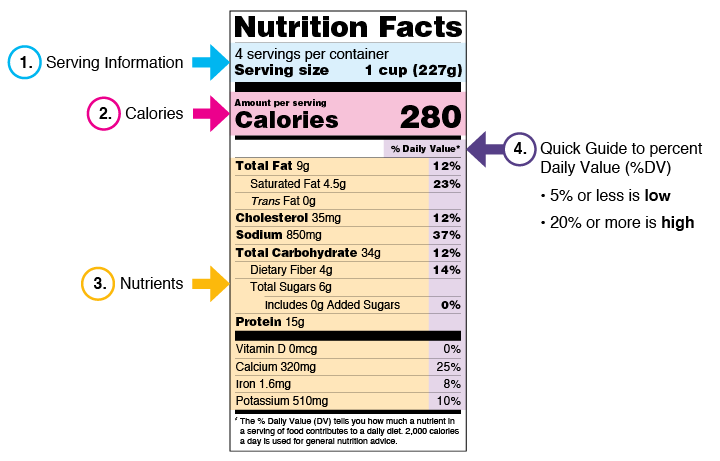
Food labels. These little labels on the side can make or break our day. Standardized food labels were initially started in 1994 as an effort to force food companies to standardize their packaging. They have been in our life for almost 30 years, but I have found that a lot of my patients do not understand how to read them. I am going to post one first and then dig a little deeper.

Source: https://www.fda.gov/food/new-nutrition-facts-label/how-understand-and-use-nutrition-facts-label

1: This is your serving size information. This tells you the serving size of the information that you will read on the label. This may or may not be the nutritional information on the whole container of food. Pay attention to how MANY servings are in the food container. So this container contains 4 servings at 280 calories each, if you ate the whole container that would be 1120 calories! The serving size has nothing to do with a RECOMMENDED serving size—it is just the AVERAGE portion a person eats-so this does not mean that you should eat 1 cup of this food, maybe you should eat more or less… It’s just giving you the information on what the average portion would be.

2: Next is the calories per serving. This is based on a 2000 calorie diet a day. 2000 calories may seem like a lot at first but that calorie count can really add up quick. Fast facts—two pieces of sandwich bread, a slice of cheese and ham can be a 400 calorie sandwich. If you add chips and a sugary drink then you are pushing 1000-half of your daily consumption. Remember when we were discussing salt—Those drive thru cheeseburgers can pack 700-1800 calories each! 😳 One thing to remember, is that the 2000 calories are an estimate, it really varies on your age, activity level, sex, height and weight. Follow the link below for the FDA recommendation.

How many calories should YOU eat??? Visit this recommendation from the FDA! https://www.fda.gov/media/112972/download

3: Nutrients are listed at the left hand side of the label at both the top and bottom. It has the things we should limit the most on the top and the things we should increase toward the bottom. So we should limit, fat, salt, and sugar—well duh! Remember added sugar is the sugar that doesn’t come naturally in the food, it’s sugar that added to make it sweet. And the label will ALWAYS have, near the bottom, the amount of Vitamin D, calcium, potassium, and iron listed because as Americans we stink at getting enough of these in our diet!

4: So think of the 5/20 rule for your daily values. This is the daily value out of the 2000 calorie average that you are supposed to eat. If you are getting 5% of something it’s very little of your daily value and if it’s 20% it’s a lot of your daily value. So that 2300 mg of salt in that cheese burger is OVER 100% of your daily value-way too much! Added sugar should not exceed 10% of your daily value,

Maybe this helped to clarify food labels a little. They are essential in trying to eat healthy and having a better balanced source of food, so now you are food label wise!

Sources: https://www.fda.gov/media/135197/download https://www.fda.gov/media/112972/download https://foodinsight.org/the-nutrition-facts-label-its-history-purpose-and-updates/

Late Blooming Hydrangea from my Garden, 10/2022

To Freeze or not to Freeze, that is the question???

So, many of my blog posts, boast about the benefits of fruits and vegetables. How many of you have bought that bag of grapes, only to look at them a week later languishing in the refrigerator?? Or the new color of produce brown? Brown, apples, brown bananas, brown lettuce, brown carrots—just brown! Rot!! Need I say more? How about money, money, money?? And right now, we could all use a little more of that! So, how does this apply to frozen food?

Well, let’s talk frozen! First, what are frozen fruits and vegetables? The frozen counterparts we eat are always picked at the very peak of their ripeness and often frozen the same day as they are picked. This helps them retain their nutrient value. When fruits and veggies are picked, they began to degrade almost immediately and start to lose their nutrients. Freezing them suddenly, stops them in time and allows them to retain their nutrients. Sometimes, freezing them actually causes an increase in the vitamins and minerals they provide. However, fresh fruits and vegetables are picked before they are ripe, and sometimes take several weeks to reach your grocery store, allowing them to ripen along the way. The problem with this ripening, is that they are not outside to absorb the healthy nutrients we expect! Frozen, fruits and vegetables also means that they are prepared to use, which means that there is no vegetable waste when you are buying or paying by the pound. And that there is less preparing them to cook!

As far as pricing goes, a quick look at Walmart locally today shows that 11 oz of fresh blueberries are $3.96 and frozen are $2.58 for 16 oz (1lb). Broccoli is $2.32 for a pound of fresh and $2.24 for 2 pounds of frozen! Double!

A couple things on canned goods, they are processed. Which means sugar or salt are usually added to help maintain the freshness. They are more expensive in terms of cost because of the canning process itself. Remember, you want to eat as close to the source as possible.

Hopefully, you have learned something about frozen vegetables and why purchasing them may make good “cents” to you! They are a healthy option and can be budget friendly! And now you are, frozen veggie wise!

Sources: https://www.healthline.com/nutrition/are-frozen-vegetables-healthy. https://newsnetwork.mayoclinic.org/discussion/mayo-clinic-minute-benefits-of-flash-frozen-produce/ https://www.health.com/nutrition/reasons-nutritionist-buys-frozen-fruits-veggieshttps://www.nib.com.au/the-checkup/fresh-vs-frozen-vegetables

Fluid Art, October, 2022

Power to the Plants, Let’s be GREEN!

Plants! I have never really considered myself much of a gardener but I have managed to keep a few plants alive during my day. As I look around my living room, I realize that I have at least 20 potted plants in my living room. One of these plants was gifted to me from my husband’s grandmother when she died, before we were married, that was over 20 years ago! That plant has survived me! So, why am I talking about plants? Especially indoor plants?

As we head toward fall, our time outdoors decreases and our indoor time dramtically increases. Research has shown that we can improve our lives with plants. A look at Healthline and WebMD both speak to the benefits of plants in your home. Both articles site research on reducing stress levels, having a sharper focus, and helping you to recover from illness faster. Covid anyone?? Having a plant in your workspace can increase your job satisfaction, and one study showed that it increased performance by 12%. At my work office, when I moved in, I moved my plants in! I share my office with Mandy, my co-conspirator FNP, and I’m sure she thought I was taking over when I moved in! I brought a Pencil Cactus with me and sat it in the window and it has grown like crazy since moving it there, believe it or not, seeing it thrive has brought us both joy!!! I had it a year before moving it there and it had not grown at all, so seeing it happy has made us happy! Simply caring for plants, can decrease your stress and give people some meaning in their life. Especially, if they have a no pet policy at their residence.

Besides the mental benefits of plants, they have been shown to be “air cleaners’. Did you know that the air in your home can be more polluted than the air in a city! I’m sure most of you are asking why? In short, the THINGS we have in our home are made with chemicals and produce what we call volitile organic compound or VOC’s. Think you haven’t even “smelled” a VOC before?? Love that “new car smell”, well that is a VOC. These compounds disperse from carpets, dry cleaning, aersols, cleaning supplies, paints, craft supplies, pressed wood furniture (it contains formadehyde), and mold. Plus a million other things! These compounds can cause childhood leukemia, cancer, and even birth defects. And, our bodies try defend us against these everyday!

Have I convinced you that you need plants in youe life yet??? Hopefully! So what are “good” air cleaning plants to have in your home?? The easiet way is to include a visual picture–cause I know that you plant clueless people are NOT gonna know there names! A lot of these plants require MINIMAL care-especially the snake plant! I literally water my snake plant once a month and sit it in the window! Current recommendation is one plant per 100 sq ft.

source: https://www.mashrita.com/29-best-air-purifying-plants-nasa-clean-air-study/
source: https://www.natureworldnews.com/articles/43725/20200427/indoor-plants-for-clean-air.htm

So hopefully, I have convienced you to buy at least one plant for you home! Be bright, stay green, by a plant they are healthy for you! Stay healthy and plant wise!

sources: https://www.cdc.gov/nceh/publications/books/housing/cha05.htm https://www.webmd.com/a-to-z-guides/ss/slideshow-health-benefits-houseplantshttps://plantcaretoday.com/indoor-plants-clean-air.htmlhttps://www.healthline.com/health/healthy-home-guide/benefits-of-indoor-plants#7-benefits

October is Breast Cancer Awareness Month

October is Breast Cancer Awareness Month! Most of you reading this has a loved one that has been affected by breast cancer. Cancer is the second leading cause of death in the United States, 25% of all deaths in the United States are related to Cancer. It is estimated that women will have a 13% chance of developing breast cancer in their life, and a 1 in 8 chance of developing breast cancer in their lifetime. Of the 4 girls, including myself, that was on my senior high school trip, one has already succumbed to breast cancer. To say breast cancer is everywhere is an understatement. Even men can get breast cancer!! That’s why knowing about and screening for breast cancer is so important!

Screening for breast cancer has at least 2 different recommendations. The United States Preventative Services Task Force (USPSTF) recommends routine screening every 2 years if a woman wants to, starting at age 40-49 and routine screening every two years after age 50, to stop at 74. The American Cancer Society recommends routine annual screening mammograms 40-55 and then you can go to every two years if wanted, only to stop at age 74. Over 75 is not recommended by either. Clinical breast examination (exam by your PCP in the office) is not recommended by either.

Mammograms have saved countless lives, and are covered by your insurance as part of your routine screening. These services are typically covered by Medicare and Medicaid. If you find yourself insured, most health departments offer some screening mammograms a year for free. There are also lost cost cash-pay options available at most hospitals and radiology centers. While mammograms are uncomfortable, they are often very short-lived and most last less than 15 minutes. But this small amount of time can save your life!

What is breast cancer? Breast cancer is simply when cells grow out of control. Signs and symptoms of breast cancer can be lumps, dimpling, nipple discharge, change in shape, thickening of breast or pain. You can also have no signs and symptoms and have cancer. Many women have natural lumps in this breast that are cysts or dense tissue in the breasts. Some women have dense breasts, breasts that have thicker tissue inside and may require additional images after their mammogram to make sure the densities aren’t cancer. Historically, having a history of dense breast tissue does increase your risk of having breast cancer, so it is important to follow through with your follow up images. Breast cancer can either be localized or metastasized—meaning spread to other parts of the body.

If you do have an abnormal mammogram it will more than likely be followed up with an ultrasound and if that is suspicious they will do a biopsy to determine what kind of cancer you have in your breast. Finding the type of cancer in your breast is essential to getting the correct treatment.

There are several times of breast cancer and determining what type you have is essential to the treatment you get. The are 4 major types are Estrogen receptive, progesterone receptive, and HER2 receptive. The last one is called “triple negative” because it is unreceptive to any of the above three receptors, making it harder to treat, but not impossible. So the types and treatments are like locks and keys, you have to have the correct treatment for the type of cancer you have. Treatments vary on the severity of your cancer from radiation, chemotherapy, surgery, immunotherapy and others. Many patients find themselves in clinical trials as new and better treatments for breast cancer are being developed all the time.

The bottom line on breast cancer is that it is everywhere and will more than likely affect someone you love and care about in your lifetime! Screening and prevention is the key to survival. THE EARLIER THE BETTER! Follow the recommended guidelines, and if you are uncertain, please discuss with your PCP. There are free and low-cost options available to help you. If you know someone that has avoided mammograms, I encourage you to encourage them to be breast wise!

Sources: https://www.cdc.gov/cancer/breast/index.htm https://www.cancer.org/cancer/breast-cancer/about/what-is-breast-cancer.html

Cacti Family, Watercolor, 2021

October 10th is National Mental Health Awareness Day!

Awareness of mental health issues has become more prevalent over the last 10 years or so. Mental health struggles are also more socially accepted in society than they have ever been. My teenage daughter can rattle off a whole litany of mental health diagnoses and associated symptoms. In my high school years, I could barely talk about anxiety or depression, and it seemed to be associated with great shame or stigma. Flash forward, 25 years or so, and things have greatly changed, but there is still room to be made.

Today we will talk a little about depression, as it is one of the most common mental health diagnoses and struggles that we deal with in primary care. Approximately, 10% of all PCP visits have depression listed as a diagnosis. Women are more likely to be depressed than men and suicide has increased at an alarming pace with the 15-24-year-old age group by 87%, 2000-2020. In 2019 alone, 18% of adults reported that they had some symptoms of depression. The biggest fear of depression is suicide, in the same year, 45,000 suicides were reported.

So what is depression exactly? The National Institutes of Health (NIH) describes it as sad, depressed, anxious, empty, hopeless, worthless and helpless. These are very common symptoms of depression that you may be able to readily identify with depression. However, let’s discuss some of the more uncommon symptoms we see in primary care that can be attributed to other things but really are depression related. Fatigue, irritability, changes in appetite, sleeping too much, difficulty concentrating, headaches, cramps, and digestive issues. Sometimes, physical symptoms are a direct result of your body dealing with depressive feelings. The worst and most irreversible is suicide. It is contemplated by the young, old, rich, poor, sad, and sometimes the most “happy” looking people. Robin Williams was known for putting on a smiling, happy, face but he ultimately took his own life, which was a surprise to many people because of his perceived persona. Your PCP may have you take a quiz in the office called a PHQ-9 to determine your feelings in the last 2 weeks. This score will help them to decide if you meet depression criteria. The higher the score, the more likely you are to suffer from depression.

Treatment for depression can include many things. The most common treatments are meds and counseling. Although exercise and eating healthy have been shown to have benefits for mental health. In primary care medications are frequently prescribed as treatment. They can be very effective in treating depression, and as a provider I have had the opportunity to see big changes in people’s lives from medicines. I want to encourage you to do a few things if you try a medication. First, give it time to work, these medicines take several weeks to reach their maximum effect. Second, these medicines don’t work the same for everyone, it may take several attempts at different dosages, or medicines to get it right. Most of the time, we find the right one. Find a provider that will see you frequently enough, to “get it right”. And finally, if you feel suicidal on medications, CALL your provider! Counseling is often the first recommended treatment and really helps you to dig deep and deal with the roots of your depression, however, with the large numbers of depression it often takes a while to get to see a counselor or therapist. A lot of times, providers start medications in the meantime. This list is not inclusive, however most people find some help with either of these treatments.

HELP! If you feel as though you may be at the end of your line please know that help is literally A PHONE CALL AWAY!

IF YOU TEXT OR CALL 988, SOMEONE WILL HELP YOU-RIGHT NOW!

Below is the questionnaire used by professionals as a baseline for depression scoring. If you find yourself answering yes to these questions, please schedule an appointment with provider to discuss depression. It DOES NOT look the same to everyone, and it’s possible that the feelings you can’t quite put a finger on, maybe depression. There is help for you.

PHQ-9, https://www.cambridgebrainsciences.com/more/articles/measure-depressive-symptoms-with-the-phq-9

Sources: https://www.mayoclinic.org/diseases-conditions/depression/diagnosis-treatment/drc-20356013. https://www.nimh.nih.gov/health/publications/depression many years of nursing experience.

Fluid Art, 2022

Extra, Extra! See all about it!!!

So, I’m generally a pretty camera shy person. You will not find selfies of any kind on my Facebook page, but my sweet fried Tony Glenn interviewed me for his YouTube channel. And y’all it has 43,000 subscribers!!! How COOL IS THAT!! I can never thank him enough for the promotion of my blog. But if you want to get to know me better or my madness. Here ya go!!!

https://youtu.be/NbrEe1hq0qA

Don’t be Salty!

Yeah, I admit, I LOVE salt! It is my downfall, give me something salty over sweet any day! So, I am essentially writing this post—for me!! Give me olives, cheese, salami—I mean you can bury me on a charcuterie board…..Wait weren’t these on the Mediterranean Diet???😂. OK, seriously, behind sugar, this is one of the most eaten substances in America, I’ll prove it to you! Do you think you don’t eat too much salt—90% of Americans DO!

First of all, you will find salt listed in your food in the nutrition label listed as sodium. Sodium is mineral that is found in salt, but a lot of your foods will use this interchangeably as “salt free, or no added salt”. So, HOW much salt do we need a day?? The Dietary Guidelines for America recommend 2,300 mg, you are thinking to yourself—well, that’s a lot…. Well, we’ll see about that. For context-ONE TEASPOON OF SALT HAS 2,400 mgs of sodium…………..

So WHY, should I reduce my sodium or salt intake? Well, this is actually pretty simple, it RAISES your blood pressure, and increases your risk of heart disease and stroke! As a PCP, I am always concerned when my patients come in with lower leg swelling, because salt, among other things, can be a cause for swelling. Recently, I had a guy in his 20’s who had a high BP, who had eaten processed lunch meat, and pork rinds for lunch and had a high blood pressure. He normally did not. What you are concerned about is the stress on your blood vessels and heart and after days of increased blood pressure, it does lead to damage. If you add this to a person who already has high blood pressure, then it can be a very dangerous combination! But why do we NEED sodium-sodium is an essential mineral that is vital to normal cell functioning. Low sodium in the body can cause nausea and vomiting, headache, seizures, brain swelling, coma, and finally death. It is very important to have salt in you body, but we can all have too much of a good thing (even me!).

So WHAT, has sodium? The TOP TEN OFFENDERS!!

  • Breads and Rolls
  • Pizza
  • Sandwiches
  • Cold cuts and meats
  • Soups
  • Burritos and Tacos
  • Savory Snacks (Junk Food)
  • Chicken (It’s the seasoning)
  • Cheese
  • Eggs and omelets

Basically, ALL MY FAVORITES!! 🙄 Can you say charcuterie??

So WHEN, do I cut out my sodium?? Limit eating out! Restaurants kill it in sodium! 71% of the sodium we eat is in processed food and restaurant food. If you don’t believe me check out the nutrition facts on a hamburger from your favorite food chain, most are 1100 mgs and over! That’s not including the fries, and the soda! EAT FRESH FOODS—eat foods that are closest to their source. Fresh fruit and vegetables. Frozen varieties of these are ok, If they are not doused in sodium sauces. Avoid canned food and frozen “microwave meals”. These meals are chocked full of sodium to aid in flavor and add freshness. Most meals have 700-1500mg of sodium a day. AVOID SODAS, they have extra sodium, you don’t need—and sugar! Consider a heart healthy diet, such as DASH (more on this diet later) . Buy lower sodium items on the list above, it you HAVE to have them (me). DRINK WATER!

Hopefully, this short blog has opened you eyes and tastebuds to the dangers and hidden dangers of salt. It can be too much of a good thing! And today, you are sodium wise!

Sources: https://www.cdc.gov/salt/index.htm https://www.cdc.gov/salt/reduce_sodium_tips.htm https://www.cdc.gov/salt/food.htm

Fall, Fluid Acrylic, 09/2022

October is Health Literacy Month

So you’re kinda scratching your head right now and asking “what or how does this apply to me”? Well this post is supposed to be relatively simple. When I worked at the hospital we used to have health literacy fairs. These fairs provided informations to healthcare workers to promote literacy in the things we do. So instead of saying, “Mr. Johnson, today we are performing a laparoscopic cholecystectomy”. You might say to him, “Good morning Mr. Johnson, I hear that you are here to have your gallbladder removed today”? He then doesn’t look at you cross-eyed and verifies that yes indeed! He is going to have his gallbladder removed today! If you notice, in my blogs, when there is terminology that I think you might not understand, I often put in parentheses what I mean. This is basic health literacy! Making sure that you understand, using words that you understand. So, why is this important to you? How many of YOU, have sit in front of your doctor, nodding yes, only to leave and think, “I have no idea what she/he was talking about”. You are not alone.

Stone cold facts: ONLY 79% of Americans can read! That means 1 in 5 people are illiterate! Of the 79% that can read, only 46% of them can read above 6th grade level-that’s barely above elementary school. Think. About. That! And that’s not including basic knowledge of health issues. That’s why this month we will become health literacy wise!

Several factors affecting literacy are not only the basic literacy requirement itself, but chronic health conditions such as pain, confusion, age, and medications for example. I have more than several patient visits when the patient could barely hold their eyes open, or they were elderly and had difficulty understanding. Nerves, I have a lot of patients say that they are nervous, or that I was more down to earth than they were expecting—I think this attributed to nursing! As a healthcare provider, it is my duty to make sure patients understand what, when, where and why. I have went to the parking lot and asked to speak to families, called wives and husbands, if there are questions about the integrity of the visit.

Improving health literacy requires communication from you as a patient as much as your healthcare provider. As a provider, we can be rushed and forget our audience. YOU have to advocate for yourself, if you don’t understand, ask again, repeat what they are saying, or ask for someone else to explain it. Ask them to use PLAIN English and small words! Even I am overwhelmed sometimes. I can guarantee what your PCP is saying IS important and you need to understand. Be an advocate for someone you know! Often, people are afraid they will “bother” someone if they ask for help. But if you know you neighbor needs the support and may be having memory issues, offer to call a loved one or go with them-you may save their life! Most often, patients do NOT understand their medications, side effects, dosing, etc. Or even the medications they are supposed to stop, having someone there for them can mean avoiding an ER visit, or worse. I cannot reinforce enough to ask your provider what your treatment plan is BEFORE you leave. They make have told you but telling you one more time is ok! My students that I have had, often tell me that they like how I tell the patient what to do 2-3 times before they leave the office. I think this just reflects on my prior nursing experience. Again, educating is WHY I took this endeavor up to begin with!

I thinking about health literacy, remember just to ASK QUESTIONS, BE AN ADVOCATE, and if you don’t understand SPEAK UP! Being health literate IS being well WISE!

Sources: https://www.thinkimpact.com/literacy-statistics/ https://www.cdc.gov/healthliteracy/basics.html

Squeeze, Fluid Acrylic, 09/2022

Hello Sunshine! Or not….

Let’s talk tanning beds and sunscreen! I literally feel the heat on me now! But seriously, some of you out there have been tanning regularly since you were teenagers. I frequently hear, “it feels good, it makes my joints feel good, it clears up my skin “, etc. Undeniably, there are instances when this may “feel” like this is the best thing in the world, and in rare instances some dermatologists make make a recommendation for brief stints in the tanning bed. But when I tell you they are generally horrible, please believe me. In 2021, alone I found, (a PCP, not a dermatologist), at least 6 melanomas on my patients, just by doing their skin exams with their yearly physicals. One of my patients was in their 20’s—yes, I said 20’s! And it is getting worse! Did you know that people of color also experience melanoma??? Bob Marley famously died of melanoma from a lesion under his great toenail! Yes, it can affect ALL races!

Let’s throw out an alarming statistic: The risk of melanoma increases by 75% when tanning bed use is started before the age of 35. Did you catch that, 75%!!!! In 2009, the International Agency for Research on Cancer (IARC) deemed tanning beds as the highest cancer risk category and labeled them as “carcinogenic to humans”. They emit two types of radiation both UV-A and B which cause DNA damage to the cells, causing them to turn into cancer. Tanning beds are mostly likely to cause squamous cell and melanoma types of skin cancer. These both can be very deadly. 1 in 8 people will die from their melanoma diagnosis! Melanoma is the second most common type of cancer in women in their 20’s. It also increases cancers of the eye, because teenagers typically forego the protective eyewear (like helmets, seatbelts, etc.). The thing about skin cancer is that the damage occurs when you are young and you may not see it until you are older! That makes tanning beds more dangerous because they give a false sense of security because damage is not readily visible.

If you do participate in tanning bed use, please do not go to more than 3 sessions in the first week. Wear eye protection, save eye patches for Halloween! Do not use intensifiers. Watch tanning with certain medications (ask your pharmacist). The beds have recommended exposure times that coincide with the lamps in the beds, follow their guidelines. And lastly, this is not an endorsement of them, my straight up 100% recommendation, it to AVOID them- in this case, FAKE is BEST!

Sunscreen is now in part regulated by the FDA-which is good because it brings this industry up to standards and prevents some deceptive labeling. Sunscreen is either broad-spectrum or not—you WANT broad spectrum sunscreen. This covers both UVA and B rays, remember those are the DNA damaging Sun-rays! All sunscreen above SPF 15 is now considered to be broad spectrum. Application is key!! Apply 15 minutes before exposure, it needs to soak in. Also, reapply at least every 2 hours, or more frequently if you are sweating or swimming. The SPF number does not correlate to the time sun exposure, it has to do with the ray blocking force. Generally, the time between 10-2 will be the time when you have the highest of amount UV radiation. SPF’s generally go to 50 or 60, and provide maximum protection. If you re fair skinned, as I am, an SPF of at least 30 may be required to prevent sunburn. They make great sunscreen for kids. Be aware of recalls! There have been several prominent brands that have been recalled lately because they contain benzene-a flammable liquid that can cause cancer (see the link in my sources).

The bottom line is this—-UV rays cause cancer, either from tanning beds or the sun. Neither option is “safer” than the other. It takes ONE sunburn as a child to damage skin cells to produce that cancer mostly likely, LATER in life. Be smart, it doesn’t have to be you, be PROUD of the skin you are in! Purple, orange, black, white or yellow! Changing the color can lead to long-term consequences. Remember, Bob?? Please advocate at your annual physical that your PCP at least give you a general skin check, if they decline, see a dermatologist-it could save your life! Use precautions, common sense, and be skin wise!

Sources: https://www.fda.gov/safety/recalls-market-withdrawals-safety-alerts/edgewell-personal-care-issues-voluntary-nationwide-recall-banana-boat-hair-scalp-sunscreen-due https://www.fda.gov/drugs/news-events-human-drugs/update-sunscreen-requirements-deemed-final-order-and-proposed-order https://www.accessdata.fda.gov/scripts/cder/omuf/index.cfm?event=NewMonograph&ID=1245EB7DED1F08847DCC4EDB3991C18DE39AF98AA3629BD7F1184B2F58850C5E&OMUFID=OTC000006. https://www.fda.gov/consumers/consumer-updates/indoor-tanning-risks-ultraviolet-rays

Blue, Fluid Acrylic, 2022