
Blood Pressure…. Everyone has one but is the one you have good or not? How do you know? For starters, most people will tell you, “I don’t have high blood pressure because I don’t feel bad”. MOST of the time, people will have NO SIGNS of high blood pressure until they are in a hypertensive crisis (more on that later). Case in point, I recently had a very spry, active, elderly gentleman in my clinic, NO COMPLAINTS—he needed to have bloodwork done for the VA. So as part of his visit we did routine vital signs. He was found to have a resting blood pressure of 210/110- that is most certainly stroke level, however, his response to me was, “I feel fine”. I am sure he did!
So WHAT is blood pressure? Blood pressure is the amount of blood pushing on the walls of you arteries. The top number is the measurement of pressure as the blood is coming out of your heart and is exerting “force” on the walls of your arteries. The bottom number is when the blood is coming back into your heart, this is when your heart is at rest and your pressure should be at its lowest. Arteries are little muscles, they clamp down to raise your pressure, and open up to lower your pressure (just like a plumbing system in your home!). This is in response to various signals from your body. If you’re dehydrated and need more water then your arteries clamp down to keep your pressure raised. If you’ve had too much salt and the accompanying water that follows, then your arteries try to open up to accompany all of that volume. There are many variations to this—but it is truly AMAZING that are body has this ability without us knowing or thinking about it!
What is a “normal” blood pressure 120/<80, is the criteria for the American Heart Association (AHA). Now as a practicing provider, there are many variations to this “rule” based on age, health status, health problems, and race. However, most guidelines specify treatment almost always at 140/90-150/90. Diabetics will get treated sooner and younger. Below is a chart for blood pressure categories.
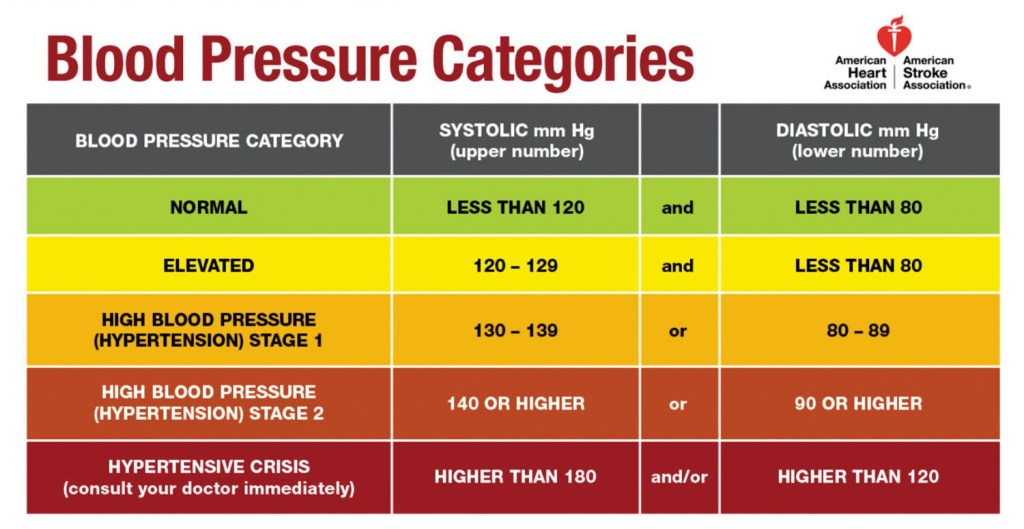
As you can see it shows numbers for a “hypertensive crisis”, most people are still ASYMPTOMATIC-meaning feeling OK-even at this pressure.
Signs and symptoms of high blood pressure
- Flushing in the face, turning red or feeling hot
- Feeling dizzy
- CHEST PAIN-see heart attack symptoms on prior post
- Spots in the eyes or blurry vision
- Severe or persistent headaches
- Stoke like symptoms, facial numbness, balance issues, weakness on one sid
It IS IMPORTANT TO TREAT HIGH BLOOD PRESSURE—YOU CANNOT CURE IT! You can make it better in some instances with lifestyle changes. However, some people are genetically inclined to have it. I treat otherwise healthy 20-year olds for blood pressure.
IF YOU EVER FIND YOURSELF HAVING ANY OF THE ABOVE SYMPTOMS, PLEASE SEEK OUT MEDICAL TREATMENT IMMEDIATELY.
NEXT post will explore the effects of blood pressure on the body, lifestyle factors that cause it, and things you can do to improve yours, and medical treatments for blood pressure.
Source: American Heart Association https://www.heart.org/en/health-topics/high-blood-pressure/why-high-blood-pressure-is-a-silent-killer


 Becoming Wellness Wise