
Food labels. These little labels on the side can make or break our day. Standardized food labels were initially started in 1994 as an effort to force food companies to standardize their packaging. They have been in our life for almost 30 years, but I have found that a lot of my patients do not understand how to read them. I am going to post one first and then dig a little deeper.
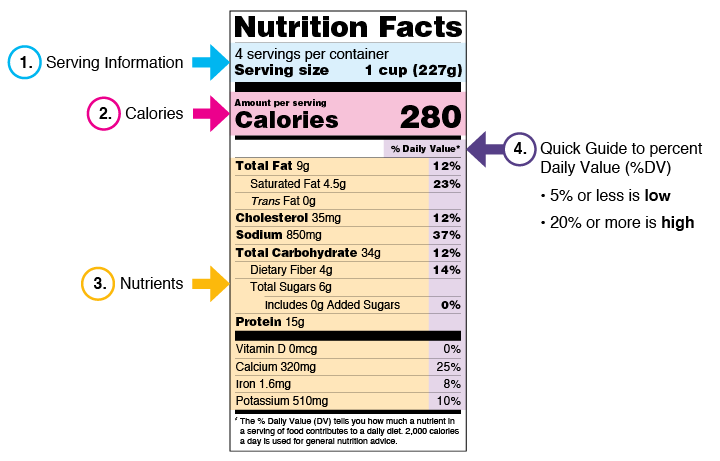
1: This is your serving size information. This tells you the serving size of the information that you will read on the label. This may or may not be the nutritional information on the whole container of food. Pay attention to how MANY servings are in the food container. So this container contains 4 servings at 280 calories each, if you ate the whole container that would be 1120 calories! The serving size has nothing to do with a RECOMMENDED serving size—it is just the AVERAGE portion a person eats-so this does not mean that you should eat 1 cup of this food, maybe you should eat more or less… It’s just giving you the information on what the average portion would be.
2: Next is the calories per serving. This is based on a 2000 calorie diet a day. 2000 calories may seem like a lot at first but that calorie count can really add up quick. Fast facts—two pieces of sandwich bread, a slice of cheese and ham can be a 400 calorie sandwich. If you add chips and a sugary drink then you are pushing 1000-half of your daily consumption. Remember when we were discussing salt—Those drive thru cheeseburgers can pack 700-1800 calories each! 😳 One thing to remember, is that the 2000 calories are an estimate, it really varies on your age, activity level, sex, height and weight. Follow the link below for the FDA recommendation.
How many calories should YOU eat??? Visit this recommendation from the FDA! https://www.fda.gov/media/112972/download
3: Nutrients are listed at the left hand side of the label at both the top and bottom. It has the things we should limit the most on the top and the things we should increase toward the bottom. So we should limit, fat, salt, and sugar—well duh! Remember added sugar is the sugar that doesn’t come naturally in the food, it’s sugar that added to make it sweet. And the label will ALWAYS have, near the bottom, the amount of Vitamin D, calcium, potassium, and iron listed because as Americans we stink at getting enough of these in our diet!
4: So think of the 5/20 rule for your daily values. This is the daily value out of the 2000 calorie average that you are supposed to eat. If you are getting 5% of something it’s very little of your daily value and if it’s 20% it’s a lot of your daily value. So that 2300 mg of salt in that cheese burger is OVER 100% of your daily value-way too much! Added sugar should not exceed 10% of your daily value,
Maybe this helped to clarify food labels a little. They are essential in trying to eat healthy and having a better balanced source of food, so now you are food label wise!
Sources: https://www.fda.gov/media/135197/download https://www.fda.gov/media/112972/download https://foodinsight.org/the-nutrition-facts-label-its-history-purpose-and-updates/


 Becoming Wellness Wise